

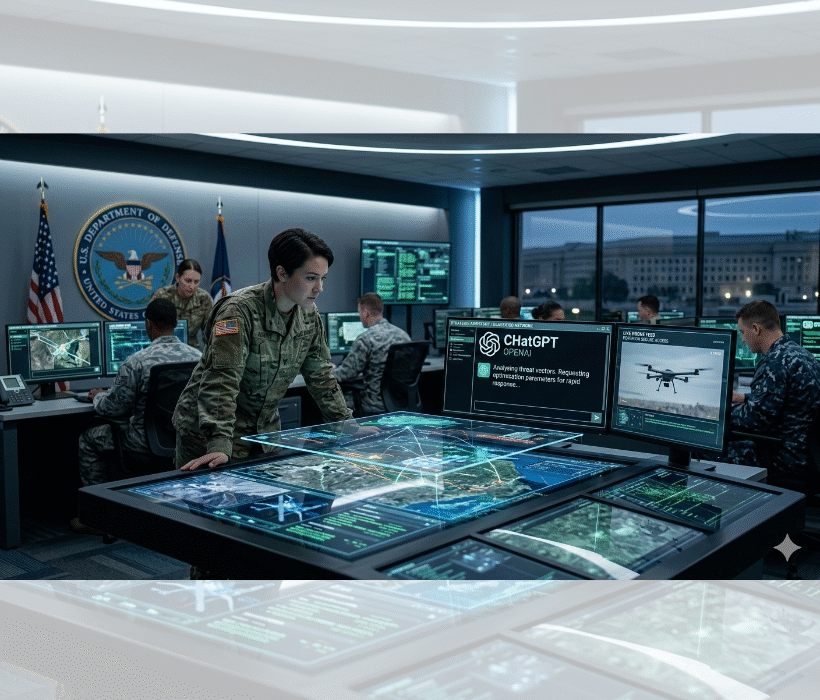
The OpenAI military contract refers to agreements between OpenAI and the U.S. Department of Defense to provide AI technology for government use. These tools help with tasks like report summarization, analysis, and operational support. OpenAI has stated that its AI will not be used for weapon targeting or weaponization.
The OpenAI US military partnership marks one of the most significant shifts in how the U.S. government approaches artificial intelligence in defense. When a leading large language model provider signs with the Pentagon, it signals that AI is no longer experimental — it’s operational. Your understanding of this deal directly affects how you interpret the future of AI national security infrastructure.
- OpenAI officially partnered with the U.S. Department of Defense in 2024
- The contract allows ChatGPT military use across select government operations
- Pentagon AI integration now includes large language models for analysis, logistics, and planning
- The deal represents a policy reversal from OpenAI’s earlier stance against military applications
- Government AI tools are now mainstream, not theoretical
What the OpenAI US Military Partnership Actually Covers
This isn’t a blanket deployment of ChatGPT across battlefield systems — it’s a structured, policy-governed rollout targeting specific use cases. The OpenAI government contract focuses on cybersecurity threat detection, intelligence analysis, and operational efficiency within the Department of Defense. Understanding the scope helps you cut through media noise and focus on what’s actually being deployed.
- Cybersecurity operations and threat response automation
- AI for intelligence analysis across large datasets
- Open-source intelligence (OSINT) summarization
- Logistics and supply chain optimization modeling
- Internal document drafting and policy research support
- Veteran support services and administrative AI assistance
How Chat GPT Military Use Is Being Implemented by the Pentagon
The Pentagon AI integration follows a controlled, tiered deployment model — not a free-for-all rollout. Specific divisions within the Department of Defense are piloting ChatGPT-powered tools through secure, access-controlled environments. Military AI applications are tested for accuracy, bias, and national security compliance before wider adoption.
- Phase 1: Pilot programs in cybersecurity and OSINT units
- Phase 2: Controlled rollout to intelligence analysis teams
- Phase 3: Broader administrative and logistics integration
- Security clearance protocols govern all AI tool access
- Output is reviewed by human analysts before action is taken
- All deployments comply with DoD AI ethics guidelines
AI Ethics in Warfare — Where OpenAI Drew the Line
OpenAI updated its usage policies in early 2024, removing previous language that explicitly banned military and warfare applications. However, the company maintains firm ethical guardrails that govern what the military can and cannot do with its models. AI ethics in warfare remains the most debated dimension of this partnership — and for good reason.
- Lethal autonomous weapons development is explicitly prohibited
- OpenAI does not permit AI-generated targeting or kill-chain decision-making
- Tools cannot be used to develop cyberweapons or offensive malware
- Surveillance tools that violate civil liberties remain off-limits
- All use cases must align with international humanitarian law principles
- Independent ethics oversight is part of the contract framework
Artificial Intelligence in Defense — The Broader Strategic Context
The OpenAI deal doesn’t exist in a vacuum — it’s part of a sweeping U.S. government strategy to dominate global AI capabilities before adversaries do. Artificial intelligence in defense is now a top-line national security priority, with billions allocated through the National Defense Authorization Act. You need to understand this context to grasp why the Pentagon moved so aggressively on AI government contracts.
- China and Russia are accelerating their own military AI programs
- The U.S. National AI Initiative has committed $2B+ to defense AI research
- DARPA, NSA, and DIA are all pursuing parallel AI integration tracks
- AI national security budgets have tripled since 2020
- The Joint Artificial Intelligence Center (JAIC) coordinates cross-agency AI deployment
- Commercial AI partnerships reduce development timelines by years
What Makes Large Language Models Valuable in Defense Operations
Large language models in defense solve a problem the military has struggled with for decades — processing overwhelming volumes of intelligence data faster than human teams can. LLMs like ChatGPT can summarize thousands of documents, identify patterns, and generate actionable briefings in minutes. That speed advantage is operationally decisive.
- Processes intelligence reports 100x faster than human analysts
- Translates foreign-language documents and intercepts in real time
- Identifies anomalies in communication patterns for threat detection
- Generates structured briefings from unstructured raw data
- Supports wargaming and scenario modeling for strategic planning
- Reduces analyst burnout by handling high-volume routine tasks
AI for Intelligence Analysis — Real-World Military Applications
AI for intelligence analysis is where the OpenAI military contract delivers its most immediate and measurable value. Defense intelligence units handle petabytes of satellite imagery, signal intercepts, financial transactions, and social media data. ChatGPT-powered tools can synthesize this into prioritized, actionable intelligence reports with speed no human team can match.
- Signals Intelligence (SIGINT): Pattern detection in communication metadata
- Geospatial Intelligence (GEOINT): Contextual analysis of satellite imagery reports
- Human Intelligence (HUMINT): Cross-referencing field reports against existing databases
- Cyber Intelligence: Identifying intrusion signatures and threat actor behavior
- Financial Intelligence: Flagging anomalous transactions linked to adversary networks
- Open-Source Intelligence (OSINT): Real-time news and social media threat monitoring
Government AI Tools — How the DoD Evaluates and Approves Vendors
Not every AI company can win a government AI contract — the procurement process is rigorous, security-focused, and politically scrutinized. OpenAI’s path to this partnership required demonstrating compliance with FedRAMP security standards, DoD AI ethics principles, and Congressional oversight requirements. Understanding how government AI tools get approved explains why this contract is competitively significant.
- Vendors must pass FedRAMP authorization for cloud security compliance
- AI models are red-teamed by DoD cybersecurity units before deployment
- Congressional notification is required for large-scale AI contracts
- Vendors sign data handling agreements protecting classified information
- Ethics review boards assess bias, explainability, and accountability
- Performance benchmarks are tied to contract renewal clauses
OpenAI vs. Other AI Contractors — Why ChatGPT Won the Pentagon’s Attention
OpenAI isn’t the only player competing for AI national security contracts — Palantir, Anduril, Google (via DeepMind), and Microsoft are all active in the space. But the ChatGPT brand, combined with GPT-4’s superior language comprehension, gave OpenAI a decisive edge in language-heavy intelligence and administrative use cases. Here’s how the competitive landscape breaks down.
OpenAI (ChatGPT):
- Superior natural language understanding for text-heavy intelligence tasks
- Broad public trust and proven enterprise deployment track record
- Microsoft Azure partnership provides FedRAMP-compliant cloud infrastructure
Palantir:
- Stronger in structured data analysis and predictive modeling
- Longer track record with classified defense contracts
- Less capable in open-ended language generation tasks
Google DeepMind:
- Advanced multimodal capabilities but significant internal ethics controversy
- Withdrew from Project Maven in 2018 due to employee protests
- Re-entering defense AI cautiously through indirect partnerships
Anduril:
- Focused on autonomous systems and hardware-software integration
- Not a language model provider — complementary, not competitive
- Strong Pentagon relationships but different capability profile
Military AI Applications Beyond ChatGPT — What’s Coming Next
The OpenAI military contract is an early chapter in a much larger story about artificial intelligence in defense. The Pentagon’s roadmap includes autonomous drone swarms, AI-powered battlefield logistics, and predictive maintenance systems that reduce equipment downtime. Your awareness of these trends positions you ahead of the curve on where defense AI is actually heading.
- Autonomous Logistics: AI managing real-time supply chain rerouting in conflict zones
- Predictive Maintenance: ML models reducing aircraft and vehicle downtime by 40%+
- Wargame Simulation: LLMs running thousands of scenario models for strategic planning
- Recruitment & Training: AI personalizing military training programs at scale
- Medical Triage: AI tools supporting battlefield medical decision-making
- Cyber Defense: Real-time AI threat response for critical infrastructure protection
The Internal OpenAI Controversy Over the Military Contract
This deal didn’t happen without internal friction — multiple OpenAI employees and researchers publicly raised concerns when the military contract news broke. The core tension is between OpenAI’s stated mission of “safe and beneficial AI” and the inherently dual-use nature of powerful language models in national security contexts. That tension isn’t resolved — it’s managed.
- Several senior researchers cited concerns about “mission drift” away from safety-first principles
- Employees questioned whether military use cases were adequately reviewed
- OpenAI’s leadership responded by publishing updated, more detailed use-case policies
- An internal ethics committee was reportedly empowered with expanded review authority
- Public pressure led to greater transparency about which military applications are permitted
- The debate mirrors historical controversies at Google (Project Maven) and Amazon (facial recognition)
AI National Security Policy — What the U.S. Government’s Framework Looks Like
The U.S. government has developed a formal AI national security policy framework that governs how commercial AI tools like ChatGPT can be integrated into defense operations. The National Security Commission on Artificial Intelligence (NSCAI) published a landmark report recommending aggressive AI adoption — while establishing accountability guardrails. That framework is what makes the OpenAI contract legally and operationally possible.
- Executive Order 13960 established principles for trustworthy federal AI use
- DoD Directive 3000.09 governs autonomous weapons and human control requirements
- The NSCAI Final Report recommended $40B in AI investment over five years
- All AI tools must be “explainable” — outputs must be interpretable by human reviewers
- Bias testing and fairness audits are mandated before operational deployment
- Congressional oversight committees receive regular AI contract disclosures
Future of AI in Defense — The Next 5 Years
The OpenAI military contract is a proof-of-concept that will either accelerate or recalibrate how aggressively the Pentagon adopts commercial AI partnerships. The future of AI in defense will be shaped by three forces: adversarial competition with China, technological maturation of autonomous systems, and evolving public and congressional tolerance for AI in warfare. You’re watching the early innings of a multi-decade transformation.
- By 2027, AI is projected to support 60%+ of DoD intelligence analysis workflows
- Autonomous unmanned systems will operate with AI co-pilots, not full autonomy
- AI procurement budgets are forecast to exceed $10B annually by 2028
- International AI arms control agreements are being quietly negotiated at the UN
- Commercial AI companies will face increasing pressure to choose sides — or opt out
- Explainable AI (XAI) mandates will reshape how LLMs are architected for defense use
Content Writing Services in Mohali That Support Defense, Tech & B2B Brands
If your business operates in the AI, defense tech, government contracting, or B2B technology space, you need content that converts — not just content that ranks. Our professional content writing services in Mohali are built specifically for high-stakes commercial topics where accuracy, authority, and persuasion all matter equally. Whether you’re targeting government procurement officers, enterprise buyers, or informed consumers, we write content that drives results.
- Freelance content writing services in Mohali for agile, project-based content needs
- Free content writing services in Mohali consultation available for new clients
- SEO-optimized long-form articles targeting high-value commercial keywords
- Technical and defense-sector content written by subject-matter-aligned writers
- White papers, service pages, and thought leadership for AI and tech companies
- Get our content writing services in Mohali contact number via the inquiry form below
Why Choose Our Content Writing Agency for Commercial and Technical Topics
You need more than a generalist writer when your content covers regulated industries, emerging technologies, or sensitive commercial territory. Our agency brings together SEO expertise, industry research capability, and conversion-focused copywriting — all in one place. We’re a top content writing services provider trusted by B2B brands, SaaS companies, and government-adjacent businesses.
- Best content writing company for AI, tech, defense, and enterprise sectors
- Affordable content writing pricing with transparent packages and no hidden costs
- Every piece of content is SEO-researched before a word is written
- Writers are briefed on buyer intent, not just topic keywords
- Edits and revisions included — no extra charges for refinements
- Proven track record of ranking commercial articles on Page 1 within 90 days
Our Content Writing Packages & Plans
We offer structured content writing packages designed for businesses at every growth stage — from startups needing foundational SEO content to enterprises running high-volume content operations. Our packages are built around results and ROI, not word count for its own sake. Every plan includes keyword research, on-page SEO optimization, and conversion-focused formatting.
- Starter Pack: 4 articles/month — ideal for new websites building domain authority
- Growth Pack: 8–12 articles/month — suited for competitive keyword targeting
- Authority Pack: 20+ articles/month — for aggressive SEO and content marketing programs
- Add-ons available: Meta descriptions, internal linking strategy, content audits
- Custom packages available for government, defense tech, and SaaS verticals
- Contact us for content writing services in Mohali contact number and a free quote
Content Writing Services vs. Hiring a Freelancer
Choosing between a professional content writing agency and a freelance writer is a real business decision — and the wrong choice costs you time, rankings, and revenue. Agencies provide consistency, scalability, and accountability that individual freelancers simply can’t match at volume. Here’s how the comparison breaks down honestly.
| Factor | Our Agency | Freelancer |
|---|---|---|
| Consistency | High — standardized briefs and QA | Variable — depends on individual |
| Scalability | Scales to 50+ pieces/month | Limited by one person’s capacity |
| SEO Expertise | Built-in — every piece is optimized | Often requires separate SEO input |
| Turnaround | Reliable deadlines with backup writers | Disrupted by illness, availability |
| Accountability | Contracts, revisions, SLA guarantees | Informal, often no recourse |
| Pricing | Transparent packages | Varies wildly, often unclear scope |
Common Mistakes When Hiring Content Writing Services
Most businesses that get poor ROI from content marketing made the same avoidable mistakes at the hiring stage. They prioritized low price over proven results, or they hired without understanding what SEO-driven content actually requires. Knowing these pitfalls protects your budget and your rankings.
- Hiring on price alone — cheap content rarely ranks or converts
- No editorial brief — writers without direction produce generic, unfocused content
- Ignoring search intent — informational content won’t rank for commercial keywords
- Skipping competitor research — your content needs to outperform what’s already ranking
- No internal linking strategy — isolated articles don’t build domain authority
- No performance tracking — if you’re not measuring rankings and conversions, you can’t improve
- One-and-done mindset — content requires consistent publishing to compound results
Results & Case Studies — What Our Content Writing Services Deliver
Our clients don’t just get published content — they get measurable improvements in organic traffic, keyword rankings, and lead generation. Here’s what businesses working with our top content writing agency have achieved within the first six months of engagement.
- SaaS Client (B2B): Grew organic traffic by 312% in 5 months with 16 long-form articles
- AI Tech Company: Ranked Page 1 for 7 high-intent commercial keywords within 90 days
- Defense Contractor Blog: Generated 4 qualified enterprise leads per month from content alone
- E-commerce Brand: Reduced paid ad spend by 30% after organic content took over top keyword positions
- Government Services Firm: Established thought leadership positioning that directly influenced 2 RFP wins
- Average client sees 180%+ increase in organic sessions within the first quarter
FAQs
What is the OpenAI military contract?
The OpenAI military contract is a formal agreement between OpenAI and the U.S. Department of Defense that permits the use of ChatGPT and related AI tools for select defense applications. These include cybersecurity, intelligence analysis, and administrative support. It does not authorize use for lethal autonomous weapons or offensive military operations.
Is ChatGPT being used for warfare and combat decisions?
No — ChatGPT military use is explicitly restricted from lethal targeting, autonomous weapons, and direct combat decision-making. The Pentagon AI integration focuses on back-office intelligence processing, logistics, and administrative efficiency. Human oversight is required for all operationally significant decisions.
Why did OpenAI reverse its policy on military applications?
OpenAI updated its usage policies in January 2024 to remove blanket prohibitions on military and national security use cases. The company determined that broad restrictions were preventing legitimate, non-harmful uses that could support national security. Specific harmful uses — like weapons development and cyberattacks — remain explicitly prohibited.
What AI ethics safeguards apply to the OpenAI US military partnership?
The partnership is governed by DoD AI ethics principles, international humanitarian law considerations, and OpenAI’s internal usage policies. AI ethics in warfare is managed through prohibited use categories, human-in-the-loop requirements, and independent ethics oversight. OpenAI has stated it will not support applications that violate these principles regardless of government pressure.
How does artificial intelligence in defense compare to traditional methods?
Artificial intelligence in defense dramatically accelerates data processing, threat detection, and scenario modeling compared to traditional analyst-driven methods. AI for intelligence analysis can process and summarize thousands of documents in the time it takes a human team to read dozens. The competitive advantage is speed, scale, and pattern recognition — not replacement of human judgment.
What are the best content writing services in Mohali for AI and tech topics?
Our agency offers the best content writing services in Mohali specifically designed for technical, commercial, and high-stakes content categories including AI, defense tech, SaaS, and B2B. We combine SEO research, buyer-intent writing, and subject-matter accuracy to produce content that ranks and converts. Contact us directly for packages, pricing, and a free sample article.
How much do content writing services cost in Mohali?
Content writing services cost in Mohali varies by volume, complexity, and turnaround time. Our starter packages begin at competitive rates designed for growing businesses, with enterprise and technical content priced according to research intensity and specialization. Contact us for a transparent, no-obligation quote tailored to your content goals.
Final CTA — Hire Content Writing Experts Who Understand AI, Defense & High-Stakes Commercial Topics
Your competitors are already investing in content that ranks, converts, and builds authority. If your website isn’t generating consistent organic leads from commercial keywords, you’re leaving revenue on the table every single day. Our professional content writing services in Mohali are built for businesses that need content to perform — not just exist.
- Get our content writing services in Mohali contact number — call or WhatsApp for a free consultation
- Free content writing services in Mohali trial article available for qualified new clients
- Choose from flexible packages — Starter, Growth, or Authority plans available now
- Hire content writing experts with proven Page 1 rankings in competitive niches
- Free SEO content audit — we’ll review your existing content and show you exactly what’s underperforming
- Results-driven pricing — your ROI is the metric we optimize for, not word count
→ Contact us today and get your first article brief within 24 hours.